EN
EN


The International Buyer’s Checklist: Key Technical Parameters for Sourcing Utility-Scale Lithium Batteries and Inverters.
Time : 2026-06-16
Introduction: Cutting Through the Sourcing Noise
The global demand for large-scale energy storage and high-power solar conversion hardware is expanding at an exponential rate. As countries accelerate their transition to renewable grids, international procurement managers, project developers, and engineering firms face a massive challenge: how to accurately evaluate and source utility-scale lithium batteries and inverters from overseas manufacturers. With hundreds of suppliers claiming superior performance, making an uninformed decision can lead to severe project delays, component incompatibilities, or catastrophic field failures. This comprehensive buyer’s checklist defines the exact technical parameters and safety standards that must be scrutinized during your technical procurement process.
1. Lithium Battery Chemistry: Why LFP Dominates C&I and Utility Applications
When evaluating battery energy storage systems (BESS), the fundamental starting point is cell chemistry. While Lithium Nickel Manganese Cobalt (NMC) cells offer high energy density, Lithium Iron Phosphate (LiFePO4 / LFP) has conclusively become the industry standard for stationary energy storage. As a buyer, you must mandate verified proof of the following battery specifications:
· Cycle Life & Depth of Discharge (DoD): Ensure the manufacturer guarantees a minimum of 6,000 to 8,000 cycles at 80% Depth of Discharge before the battery capacity degrades to 80% of its original nominal value. This ensures an operational lifetime exceeding 15 years under daily cycling conditions.
· Thermal Management Architecture: For large-scale configurations, prioritize systems utilizing advanced Liquid Cooling over traditional forced-air cooling. Liquid cooling maintains a highly uniform temperature differential across all internal cells (typically within ±2°C), preventing localized hot spots, extending overall battery life, and reducing parasitic fan energy consumption.
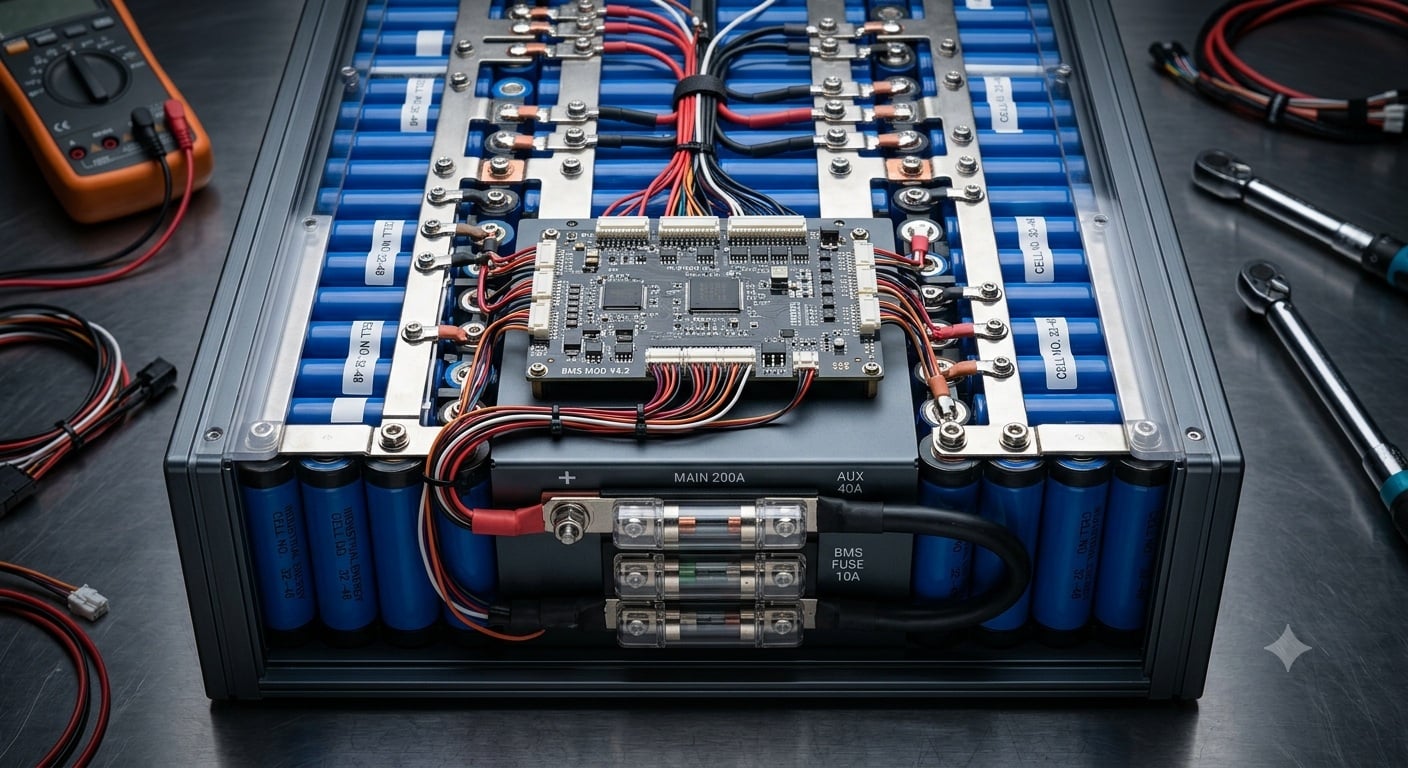
· Battery Management System (BMS) Granularity: The system must feature a multi-tier BMS (Cell-level, Module-level, and Rack-level) equipped with active cell balancing and real-time monitoring of voltage, current, and insulation resistance.
2. Inverter Metrics: Efficiency, Topology, and Transient Response
The inverter dictates how safely, efficiently, and rapidly your stored DC energy is transformed into usable AC power. When reviewing inverter datasheets, do not look only at the basic kilowatt rating. You must demand clarity on these advanced electrical metrics:
· Euro / CEC Efficiency: Always prioritize the European or California Energy Commission (CEC) weighted efficiency ratings over the 'maximum efficiency' spec. Weighted efficiency provides a much truer reflection of how the inverter performs across varying load levels throughout a typical operating day. Look for ratings above 98.2%.
· Overload Capability and Inductive Load Management: Commercial systems frequently experience massive inrush currents from electric motors, pumps, and compressors. Ensure the inverter possesses a robust overload capacity—ideally supporting 110% continuous output and up to 150% surge output for short durations (typically 10 to 60 seconds).
· Total Harmonic Distortion (THD): To protect sensitive downstream electronics and automated industrial machinery, the inverter's output wave must be ultra-clean, featuring a current THD of less than 3% at rated power output.
3. Non-Negotiable International Safety and Compliance Certifications
Hardware that lacks verified compliance with regional and international standards is completely worthless, as local utility companies will flatly refuse grid interconnection permission. Your Request for Proposal (RFP) documentation must require full compliance certificates for the following global standards:
| Component | Target Market | Required Vital Certifications |
| Lithium Battery Systems | Global / Europe | IEC 62619 (Safety for industrial applications), UN38.3 (Transport safety) |
| North America | UL 1973 (Batteries for stationary applications), UL 9540A (Large-scale fire testing) | |
| Solar & Hybrid Inverters | Europe | EN 50549 / VDE-AR-N 4105 (Grid connection compliance) |
| North America | UL 1741 SB (Inverters with smart grid functionality) | |
| Global | IEC 62109-1 / -2 (Safety of power converters) |
Conclusion & Call to Action
Sourcing high-end renewable hardware requires a rigorous commitment to technical due diligence. By focusing heavily on LFP cell longevity, advanced liquid cooling, high inverter surge capacities, and rigorous international safety certifications, procurement professionals can effectively insulate their investments from technical and regulatory risks.
Streamline your technical procurement process. Download our complete Sourcing Specification Template to easily copy and paste standardized technical requirements directly into your company’s next solar and storage RFP.