EN
EN


Designing a Resilient C&I Solar-Plus-Storage System: How to Solve Grid Instability and High Peak Tariffs
Time : 2026-05-14
Introduction: The Double Dilemma facing Modern Factories
Commercial and Industrial (C&I) facilities today face a dual threat to their operational profitability: highly volatile grid electricity prices and an increasing frequency of unexpected power outages. For energy-intensive industries—such as cold chain logistics, precision manufacturing, and data centers—even a momentary drop in power can lead to catastrophic financial losses, ruined inventory, and costly production downtime. Relying solely on the traditional utility grid is becoming a high-risk operational strategy.
The most effective, future-proof solution lies in the implementation of an engineered solar-plus-storage system. This guide provides a step-by-step breakdown of how to correctly design and size a commercial solar, lithium battery, and inverter system to successfully mitigate grid instability and eliminate punitive peak demand charges.
Step 1: Evaluating Your Load Profile and Identifying Peak Tariffs
Before selecting any hardware, you must thoroughly analyze the facility’s historical energy consumption data, typically obtained through 15-minute interval utility billing meters. This allows you to construct a clear Load Profile. You need to identify two critical factors: 1. Peak Demand (kW): The highest amount of power drawn from the grid at any single moment. Utilities often charge hefty 'demand charges' based entirely on this single peak hour. 2. Time-of-Use (ToU) Tariff Windows: The specific hours of the day when the utility charges the highest rates for electricity.
By mapping these factors against the local solar irradiation data, you can pinpoint exactly when your building consumes the most expensive power and determine how much of that load can be directly covered by real-time solar generation.
Step 2: Sizing the Core Components for Maximum Synergy
A poorly matched solar-plus-storage system results in either wasted capital or inadequate backup power. The components must be sized harmoniously:
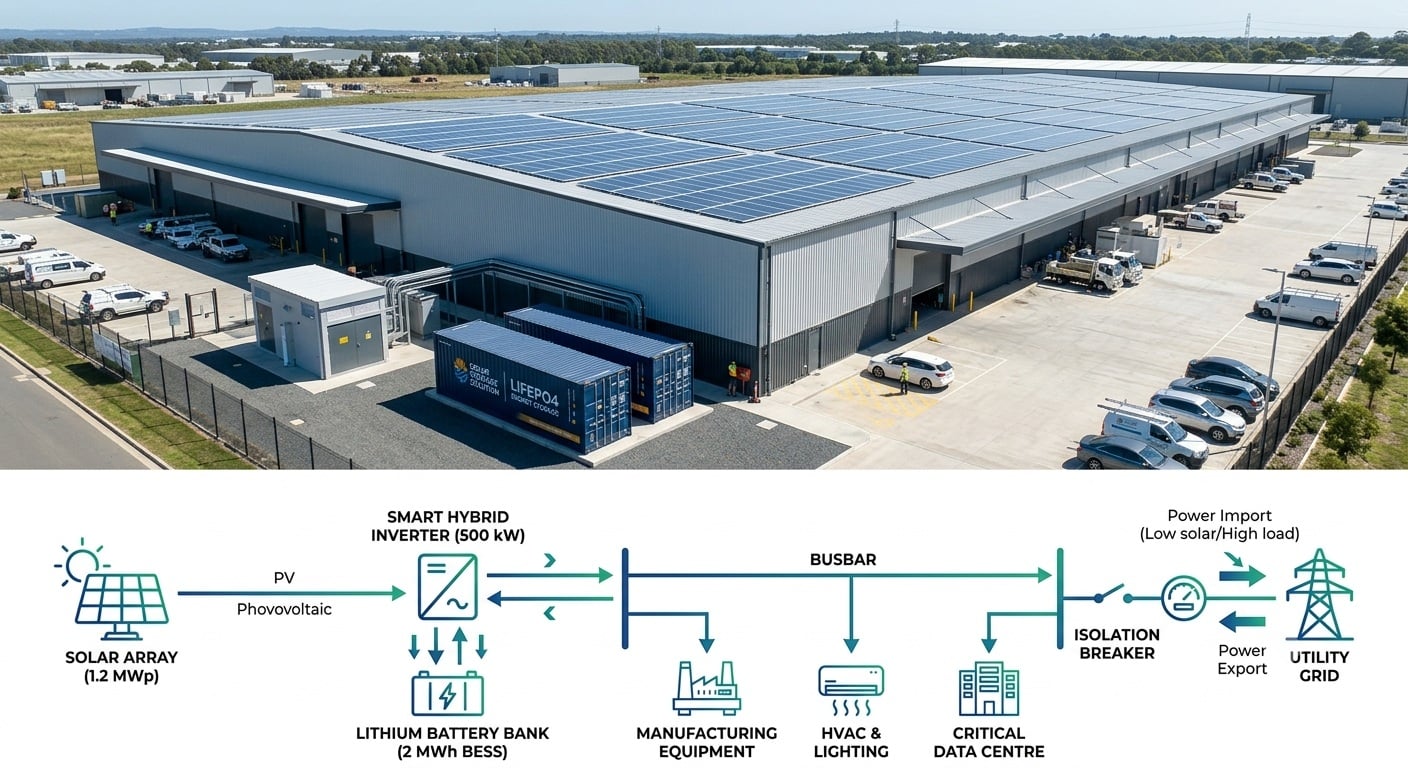
· Solar Module Sizing: Calculate the total usable roof space, accounting for shading from HVAC units and parapet walls. Optimize the array capacity to not only cover daytime operational loads but also to provide enough surplus energy to fully recharge the battery storage system before sunset.
· Lithium Battery (CESS) Capacity: Lithium Iron Phosphate (LiFePO4) chemistry is the gold standard for C&I applications due to its high thermal stability and long cycle life. To combat high peak tariffs, size the usable battery capacity (kWh) to completely cover the facility's consumption during the peak ToU window, a strategy known as 'peak shaving.'
· Hybrid Inverter Integration: The inverter capacity (kW) must be robust enough to handle both the total solar input power and the maximum critical load required during an unexpected grid blackout. Ensure the inverter features a seamless UPS-class transfer time (less than 10 milliseconds) to prevent computers and machinery from resetting during a power failure.
Step 3: Implementing Intelligent Energy Management Strategies
The physical hardware is only as effective as the software controlling it. To maximize your Return on Investment (ROI), the system's Energy Management System (EMS) must be programmed to execute sophisticated operational modes:
| Operational Mode | Core Objective | How it Works |
| Peak Shaving | Lower Demand Charges | The EMS monitors grid draw in real time. When consumption approaches a predetermined threshold, the battery instantly discharges power to absorb the excess load, keeping grid demand flat. |
| ToU Optimization | Avoid High Electricity Rates | The battery charges during off-peak hours (or via surplus daytime solar) and discharges exclusively during high-rate evening hours, minimizing expensive grid reliance. |
| Backup / Island Mode | Ensure Operational Continuity | The system maintains a designated reserve capacity (e.g., 20% State of Charge) at all times. If the grid fails, the inverter isolates from the utility and creates a secure local grid, drawing power from solar and batteries to run critical operations uninterrupted. |
Avoid Common Design Pitfalls
When sourcing components, many buyers make the mistake of choosing low-cost, mismatched equipment from separate vendors. This frequently leads to severe communication protocols conflicts between the battery’s BMS (Battery Management System) and the inverter’s firmware, resulting in inefficient charging cycles or unexpected system shutdowns. Opting for a single-source, pre-engineered solar-plus-storage solution guarantees seamless CAN/RS485 communication, simplifies the installation process, and provides a unified warranty pathway.
Conclusion & Call to Action
Designing a truly resilient commercial solar-plus-storage system requires a deep understanding of your facility’s unique energy footprint. By matching high-efficiency modules, industrial-grade LiFePO4 batteries, and smart hybrid inverters, your business can successfully take complete control of its energy future.
Need assistance optimizing your system configuration? Use our Online C&I Solar & Storage Sizing Calculator to estimate your potential savings, or schedule a detailed technical consultation with our engineering application team today.